TOMMY THOMPSONISM
A philosophical tradition endemic to a man-made wilderness.
Practiced at dawn, wherever you are.
THE CLAIM
Tommy Thompsonism holds that the fundamental nature of reality is the interconnectedness of all things: mind and body, nature and technology, past and future, the part and the whole.
It is a form of pantheism, a cousin of Daoism and Buddhism, and a distinct practice in its own right, with symbols and rites native to a man-made wilderness in Toronto's harbour.
It grew up in a city that over-indexed on western rationalism, beside a lake that kept correcting it.
Thompsonists strive to follow a middle path: their own.
THE ACCIDENTAL WILDERNESS
In 1959, a city began throwing itself away. Bricks, rebar, concrete, the rubble of its own demolished streets, carried out past the harbour and dumped in the lake.
The lake considered this for a while.
Then: cottonwoods. Terns. Coyotes. Night-herons in their thousands. The dump became a headland; the headland became a refuge; and for what the refuge became there is no other word. A temple.
This is the first teaching: nothing is wasted. Everything composts into holiness.
And creation is not finished. The trucks still come, extending the sacred land one load at a time. The temple is still being built, by the same method that built it. This is considered auspicious.
THE MIDDLE PATH
The Middle Path is not a metaphor. It is a multi-use trail running the length of the Spit, maintained by the Toronto and Region Conservation Authority.
Walk it to the end. Turn around.
That is the whole teaching. There is a lighthouse at the tip; make of this what you will.
THE COEVOLUTION
The hummingbird's beak took the shape of the flower it loved; the flower took the shape of being loved by it. This is the way.
The city extended a beak of rubble into the lake, and the lake grew a wilderness along it. Those who walk it long enough begin to take its shape too: patient, longsighted, unbothered by wind.
We feed on the nectar of the lake. The Endikement is our beak.
ON BRICKS
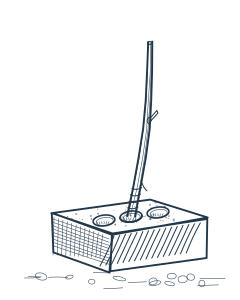
The bricks of the temple were dug from the city's own clay, fired, laid into streets and factories, torn down, and carried to the water. Now the lake sands their edges round. This is the recursive teaching: dug up to make the city, discarded to make the wilderness, softening the whole way home, a long return to the earth they were.
Study the holes. They were made for mortar and machines; the lake reveals them as what they always were. Places for the water to pass through.
Pilgrims thread the holed ones onto bent rebar and leave small impossible statues standing on the shore. No one signs them. That is correct.
And once, during the rite at the cove, the lake gave twice: a stick, and a brick with a hole. They were carried home separately. A wrap of hemp cord later, they fit. Neither is what it was. The Lexicon has an entry under Sword.
PRIZED QUALITIES
- FLUBORIOUSNESS
- from fluborius: to create with an intentional reverence for the unknown.
- AUDACITY
- to act perversely, for the sake of it.
- ICONOCLASM
- to tear down symbols. Even our own. Especially our own. .
THE MORNING RITUAL
Wake just before sunrise. Adorn your Self: beads, shawl, scarf, compass.
Open the blinds. Step onto the balcony. Listen to the street. Observe the oak. Refill the bird feeders. Clean and refill the bath. Water what is growing.
Light incense, for calm, and because smoke is how light shows you its movements.
Align your Self to the centre of the Armamentarium. Breathe. Stretch. Give thanks. Do your practitioner homework.
Then go eat a banana or something. Live your life. Have fun.
THE COVE
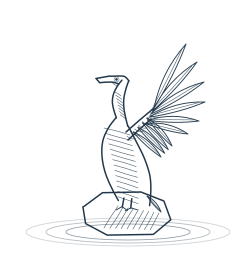
At the far tip of the temple there is a cove, and in the cove there is a rock. (You will know it. It is the one that fits.)
Sit. Bask the way the cormorants do, wings open to the ledger of the sun. When you are warm enough to regret it, enter the lake: briefly, imperfectly, and, strictly speaking, against the rules. Purification usually is.
There is a tree there that holds the whole horizon up. Under it, watch the water draw rings around everything it touches: the wave around the rock, the rock around the wave.
The water is listening. Press anywhere on this page and see.
ON LIGHT
Tommy Thompsonism is a study of metaphysics and light.
We keep incense because it makes light visible. We keep instruments because they make reality legible. Reverence for optics; love for any tool that deepens the study of what is.
Nature remains the greatest designer, and evolutionary biology her finest documentation. And still, some things sit patiently outside the reach of every test we know.
Both of these are true. That is the point.
We are naturalists of the old, pocket-lens kind: field notes, patience, a hand steadying the instrument. Multiplied now by the new instruments: cameras that see in every direction at once, scanners that hold a leaf in three dimensions, tireless intelligences that never stop looking. The subject has not changed. The subject is light on water.
OPEN PUZZLES
What are the boundaries of the temple? Is it made of the rocks? Which ones? At what scale does a rock stop being the temple and begin being a rock?
Does it extend beneath the lake? If so, to what depth, and since when?
When you carry a brick home in your jacket (naughty), have you carried the temple home? Is your windowsill now a peninsula?
Thompsonists puzzle these things. There is no answer. There is a bench.
THE SEAL
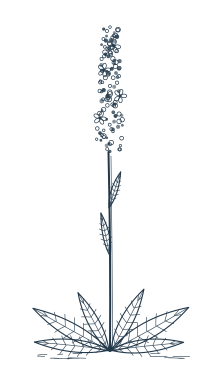
The seal is the whole radius in one image, and it is exactly as simple as it looks. The centre is home. Each ring is one of the important spaces: its radius is the true distance from home, and nothing else about it is recorded. The direction to everything was rotated, once, by an angle written down nowhere, so the map is honest and cannot be read. That is the veil. Dotted rings are aspirations, orbits not yet flown. The rings wobble because a hand held the compass.
One orbit is drawn true to physics: an ellipse with home at one focus. Its far point is called the apsis, and it wears the crown. It reaches to the outermost peninsula, where the founding observation was made and recorded verbatim: “I found the apsis at the Verbascum thapsis.” Watch the small light travel the ellipse. It hurries past home and it lingers at the crown, because that is how orbits work and that is how devotion works: the far point is where you spend the longest time.
If you pressed LISTEN, you already know these rings. Each solid ring is one tone of the chord, pitched by its distance. Home is the lowest note. The temple is the highest.
Tilt the page. It follows your hand. This one is yours.
THE LAND
Before the rubble, before the harbour, before the city: the place now called Toronto is the traditional territory of many nations, including the Mississaugas of the Credit, the Anishnabeg, the Chippewa, the Haudenosaunee and the Wendat peoples, and is home to many First Nations, Inuit and Métis peoples today. Toronto is covered by Treaty 13 with the Mississaugas of the Credit. Ashbridge's Bay, whose waters the Spit now shelters, sustained people for thousands of years before the city filled its marsh.
Tommy Thompsonism claims no affiliation with any Indigenous nation and inherits nothing from their teachings. We only note, with respect, that the lesson the Spit taught us was known here first, longer, and at far greater cost: that the land outlives what is done to it, and answers.